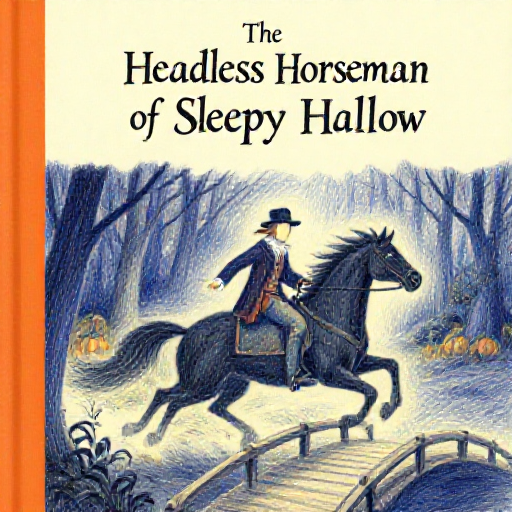
Chapter One: The Hollow
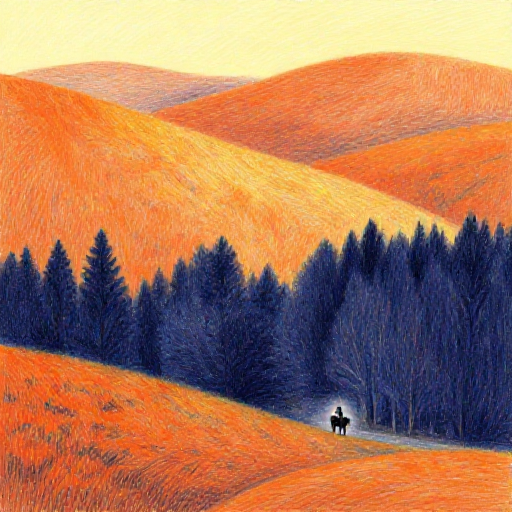
The village of Sleepy Hollow sits in a cleft of the Hudson Valley hills, where a small tributary called the Pocantico River winds through the trees. The Dutch settled it in the 17th century and named the valley something that translates, approximately, to the Sleepy Country.
They meant it as a description, not a warning.
The valley has a particular quality to it. The hills close in. The trees grow dense. Sound behaves strangely there. An echo will come back from a direction that makes no sense. A voice can carry when it should not, and be swallowed when it should carry.
The local people in 1790 knew the road through the Hollow the way you know a neighbor you have lived beside long enough to stop trusting entirely. You know their habits. You know when to watch yourself.
Ichabod Crane arrived from Connecticut in 1789 and did not know any of this.
Chapter Two: The Schoolteacher
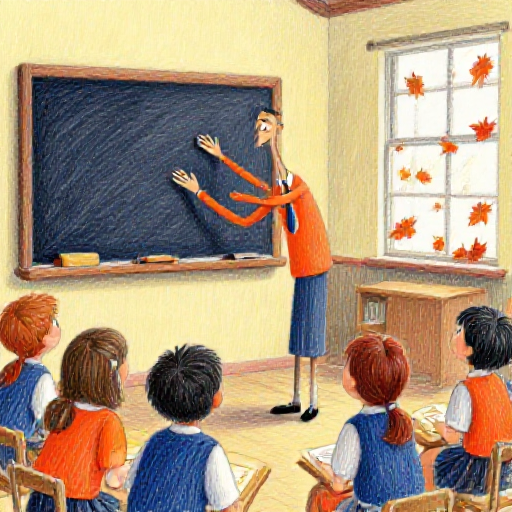
He was tall, thin, angular. Long hands, long neck, eyes that were wide and a little too quick to move, as if he was always calculating distances. He taught school and believed in the literal truth of everything he read, which made him both educated and credulous, which is a particular kind of dangerous.
He had read Cotton Mather extensively. He believed in witches. He believed in omens. He whistled psalms walking home at night because he had read that this helped.
He was also, for a schoolteacher in a small valley, intensely interested in wealth. He had fixed his attention on Katrina Van Tassel, the daughter of a prosperous Dutch farmer. He had visited the farm. He had looked at the land, the orchards, the livestock.
He had also fixed his attention on the food. He thought about the food a great deal.
He was not a subtle man.
Chapter Three: The Party
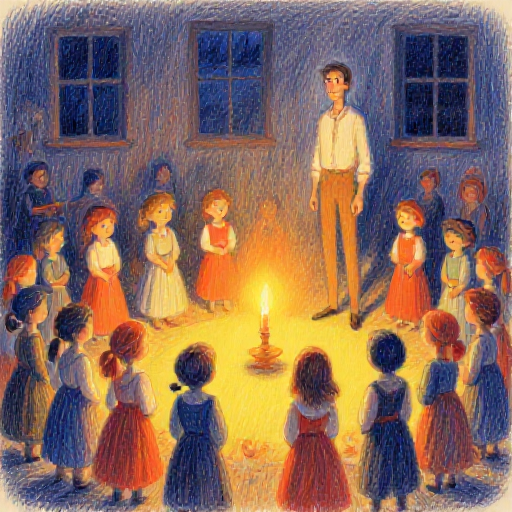
In autumn, Baltus Van Tassel threw a harvest party and Ichabod was invited, as the schoolteacher was always invited to such things. He arrived early. He ate a great deal. He danced with Katrina. He was happy.
Abraham Van Brunt was there. Brom Bones, they called him. Large, confident, the kind of man who fills a room before he opens his mouth. He was also interested in Katrina. He did not like Ichabod. He showed this through elaborate practical jokes, all of which Ichabod chose not to fully understand.
Late in the evening, the talk turned to the Hollow's ghost. The Headless Horseman. A Hessian soldier from the Revolutionary War, killed by a cannonball, buried in the churchyard, who rode out at night looking for his head. The story was told with relish, the way such stories are told at parties, and the firelight was comfortable, and Ichabod laughed along.
Then the party ended and he had to ride home alone.
Chapter Four: The Road
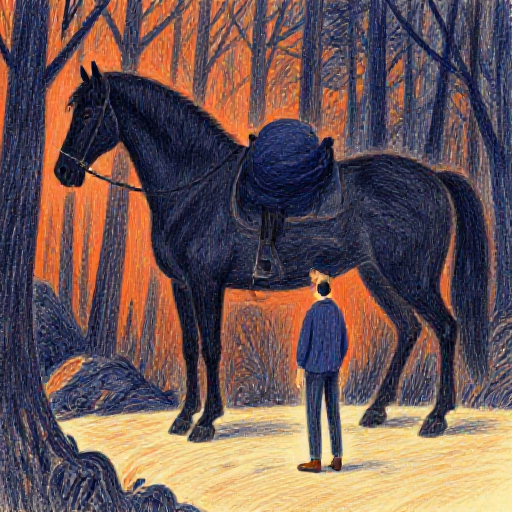
It was a long ride and a dark one. The road wound through the Hollow and past the places the storytellers had named. The tulip tree with the hollow trunk. The small bridge. The churchyard where the Hessian was said to be buried.
Ichabod was not comfortable.
He heard things in the trees. He told himself: branches. He saw shapes in the darkness. He told himself: stumps, brush, the way darkness rearranges familiar things.
Then, at the edge of the marsh near the bridge, he heard something different.
Hoofbeats. Behind him. Slow at first, matching his pace, then not.
He looked back.
The figure on the black horse had no head. It carried something on the saddle pommel that Ichabod did not look at directly. It sat straight and easy in the saddle, the way a soldier sits. It was in no hurry.
Ichabod kicked his horse to a gallop.
Chapter Five: The Bridge
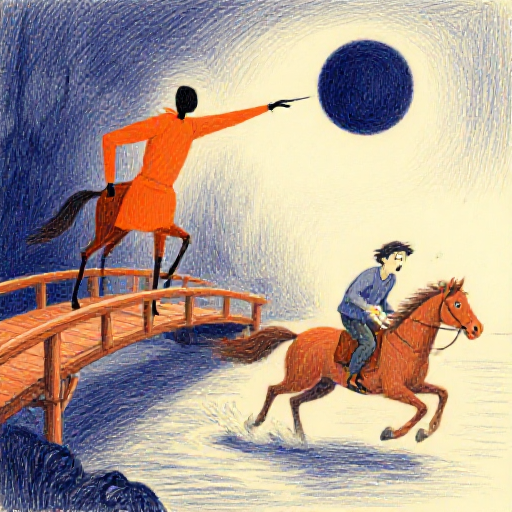
The bridge was the point. Everyone who knew the story knew this: the Horseman could not cross running water. If Ichabod could reach the bridge, he was safe.
He could hear the Horseman behind him. The hoofbeats on the road, gaining. He did not look back again. He crouched low over his horse's neck and the horse ran.
The bridge came up and he crossed it and he heard himself make a sound that was not quite a prayer.
He looked back.
The Horseman was at the bridge. And then the Horseman threw his head.
Ichabod was struck. He went down. His horse ran on without him.
The night was quiet after that.
Chapter Six: The Morning
They found the horse grazing at the Van Tassel farm before dawn. The saddle was empty.
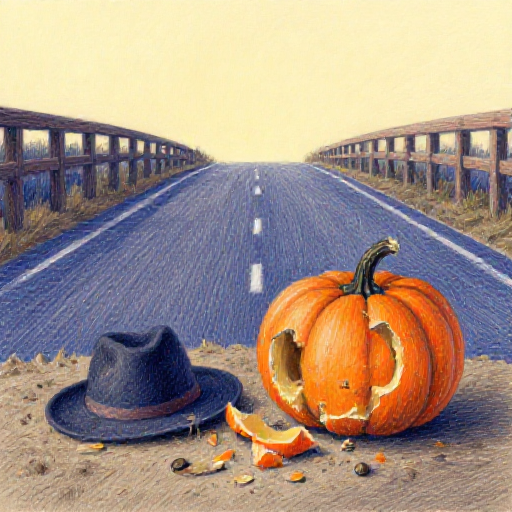
A search of the road found Ichabod's hat, trampled. Near it, a shattered pumpkin.
No body. No Ichabod. No blood.
He was gone.
The village talked about it. Some said the Horseman had taken him. Some said he had been frightened so thoroughly that he simply kept running, that he had crossed the bridge and the county line and the Hudson River and never stopped. A few people noted that Brom Bones, at the party, had laughed a particular way at certain moments in the telling of the Horseman story.
Brom Bones married Katrina Van Tassel that winter.
He never spoke of Ichabod Crane except to laugh. He always laughed most at the part about the pumpkin.
The road through the Hollow is still there. It is still dark at night. The bridge has been rebuilt several times.
Hoofbeats on the road behind you, at night, in the Hollow, still sound very much like hoofbeats.
The True History
"The Legend of Sleepy Hollow" was written by Washington Irving and published in 1820 as part of "The Sketch Book of Geoffrey Crayon, Gent." Irving based the setting on the real village of North Tarrytown, New York, which sits in the Hudson Valley near a small river and an old Dutch Reformed church with a churchyard. The village officially changed its name to Sleepy Hollow in 1996, partly in recognition of Irving's story. The churchyard Irving described, with the grave of a Hessian soldier, is real. The bridge is real. Irving walked the road himself.
The story's deliberate ambiguity about what actually happened, natural prank or genuine supernatural encounter, is central to its design. Irving leaves enough evidence for both readings. Brom Bones's laughter at the right moment, combined with the shattered pumpkin rather than an actual severed head, suggests strongly that Ichabod was pranked by a rival and ran. But Irving never confirms it. The story was written during a period of intense American interest in establishing a native folklore tradition, and Irving understood that a story without a definitive answer would outlast a story with one.
Ichabod Crane was based partly on a real schoolteacher named Jesse Merwin who taught in the Sleepy Hollow area in the early 19th century, and partly on a real Jesse Ichabod Crane, a soldier from Kinderhook, New York. The Van Tassel farm is based on a real property. The Headless Horseman himself is rooted in a much older European tradition of headless riders, common in German, Irish, and Scandinavian folklore, that the Dutch settlers of the Hudson Valley would have carried with them from the old world into the new.