The Woman Who Comes Before
She does not come to kill you. I need to say that right now, at the top, before we go any further, because otherwise you are going to spend this entire story bracing for the wrong thing.
She is not a monster. She is not a curse. She is more like a weather alert. Except instead of telling you about rain, she tells you someone is going to die. And instead of coming from your phone, she stands outside your house at three in the morning and screams.
Cool. Great. Love that for the O'Neills.
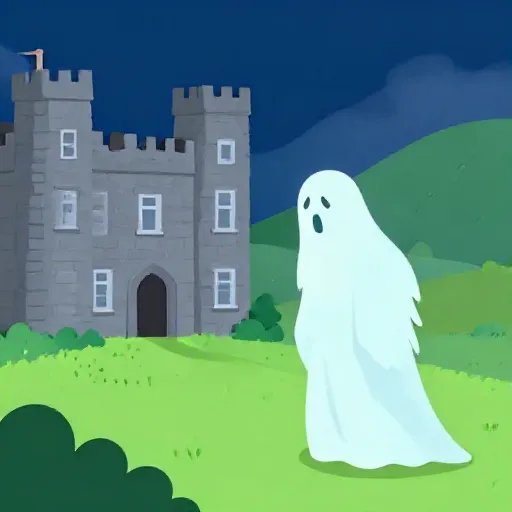
The O'Neills have held land in Ulster since before anyone was writing things down. Lords of Tir Eoghain. High Kings. Big deal family. And at some point, a very long time ago, something attached itself to their bloodline. Not to the land. Not to the house. To the blood. The way a subscription follows your email address even after you move. You cannot cancel it. You cannot transfer it. You just have it.
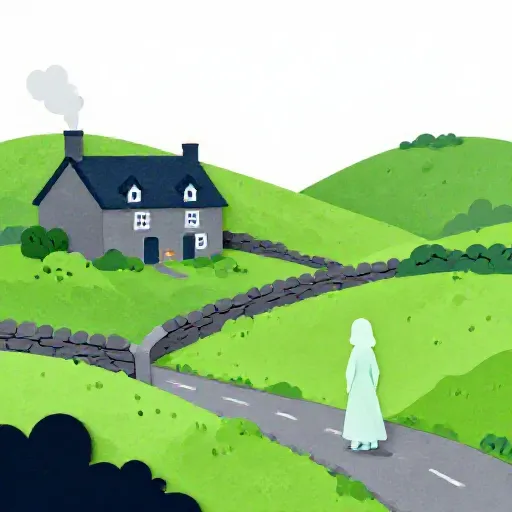
The roads through Ulster are older than English. Stone walls run between fields that stay wet long after the rain has stopped, the grass so green it looks like it is running its own lighting. Out here, the families have always known certain rules. Keep the fire lit past dark. Leave milk out. Respect what you cannot see, because what you cannot see has been around longer than you and has not once felt the need to introduce itself.
And if you hear a woman crying in the dark? Do not go looking for her.
She was here before the O'Neills knew her name. She will be here long after they forget it.

What Her Name Means
In the old Irish language, her name is bean sidhe. Woman of the fairy mound. Which sounds quaint and almost nice until you learn what it actually involves, at which point it sounds like what it is, which is a job title for the saddest job in the supernatural economy.
She is not a ghost. Ghosts are dead people with unfinished business. She was never a person. She is older than ghosts. She was here before people decided that the living and the dead were two separate departments, which is a relatively recent idea in Ireland. The line between them was always soft in the old hills. Soft the way a border is soft in fog. You cross it before you realize you have crossed it, and by then you are somewhere else.
Her job, if you can call it a job, is grief. Not the manageable kind. Not the kind you handle with tea and a walk and a few days of being quiet. The deep kind. The kind that starts below language and pulls sound out of the body the way wind pulls sound from a wire stretched between two posts. A sound that is not a scream and not a wail but something underneath both. Like the ground note of a bell that keeps humming long after the ringing has stopped.
The O'Neills did not choose her. They did not put in a request. She attached herself to their blood a very long time ago and she has never let go. Not through wars. Not through famine. Not through centuries of the family scattering to countries that did not exist when she first started watching.
The blood is the thread. The thread does not break. It does not matter how far you move. Boston. Brisbane. The grey suburbs outside Belfast. She has the thread and the thread has range.
The Two Faces She Wears
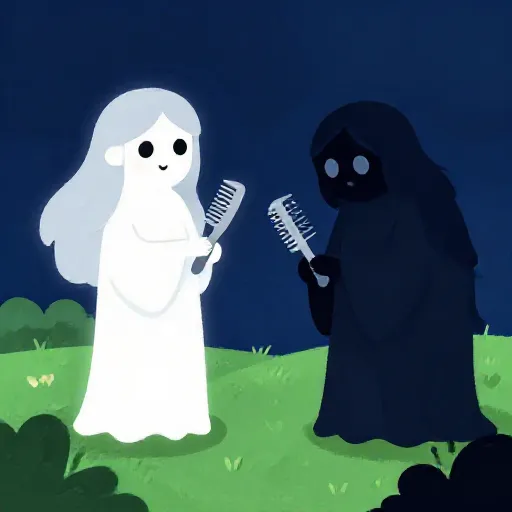
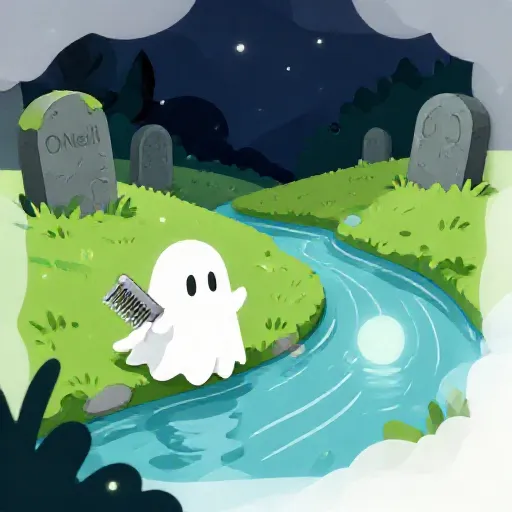
Some people have seen her young. Pale as birch bark. Sitting by a stream at dusk, combing hair the color of winter moonlight with a silver comb that catches light from a source nobody can identify. Her gown is grey-green, like lichen on stone. Her face is beautiful and perfectly still, in the way a face looks when it has already accepted something that has not been announced.
Others have seen her old. Hunched in the hedgerow shadow like something the wind forgot to take. Hollowed cheeks. Eyes red from crying so long that the crying has become the same thing as seeing. Fingers thin as bare branches in January, wrapped around the same silver comb.
Both descriptions are true. She is whatever grief needs her to be.
For a young person taken too soon, she comes young. Beautiful and already ruined by what she knows. For someone at the end of a long life, she shows her age. Which is the age of the hills. Which is very old.
Here is the unsettling part. She is not frightening because she looks frightening. Plenty of things look frightening and are totally fine. Halloween decorations. Angler fish. That one neighbor who jogs at four in the morning. All harmless.
She is frightening because she has already finished grieving something that has not happened to you yet. She is crying about your future. She has done the math. She has seen the answer. And she showed up early because she always shows up early. She has never once been late.
You can pull the blanket up a bit for this next part if you like.

The Sound That Means Someone Is Leaving
You will hear her before you see anything. Before the dog stops barking and presses itself flat against the floor with its ears pinned back. Before the fire in the hearth dips for no reason. Before anything.
The sound.
It is not exactly a scream. Not exactly a wail. Something between the two and below both. A long, held note of sorrow that seems to come from the ground as much as the air, as if the fields themselves were remembering something they had been trying to forget.
The old people in the hills of Tyrone and Antrim knew it. When it came across the bog at night, they stopped whatever they were doing. Set down the cup. Let the needle rest in the cloth. Sat very still in the kitchen with the fire ticking and the clock loud in the sudden, total silence.
Someone in the O'Neill line would be dead before morning.
I want to be clear about something. She does not make it happen. She is not the cause. She is the notification. She knows before you do, the way animals know about weather before the sky changes. The way your body knows about illness before your mind agrees to notice. She is tuned to a frequency you cannot hear, and when she cries, it means the thread between your family and hers has gone taut.
She does not enjoy this. She has never enjoyed this. She has been doing it for over a thousand years and she has not gotten used to it.
That is the part that gets me. She is not numb to it. After a millennium of doing this, every single time, she still cries.
The Man on the Road from Dungannon
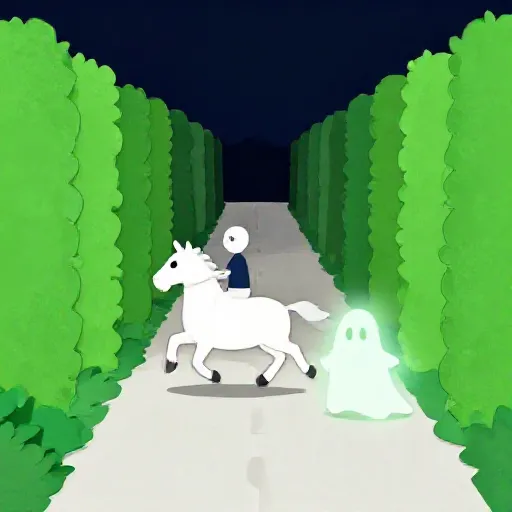
There is a story about a man riding from Dungannon to Armagh on a night in the early 1800s. These are real towns. You can find them on a map. The road between them still exists, and it still runs between hedgerows of hawthorn and bramble that stand taller than a man on horseback. Walls of black branches on both sides. No streetlights. No exits. Just the road.
He heard keening from the ditches. Low at first, like wind through a gap in a wall. Then rising. Then so close it seemed to come from inside the hedge itself, from somewhere just behind the leaves, matching the speed of his horse. Stride for stride. Without effort.
That is the detail that gets you. Without effort. He was galloping. She was keeping pace the way you keep pace with someone walking. She was not even trying. This thing has range. This thing has Wi-Fi before Wi-Fi.
He arrived home in a state of cold dread that had settled into his chest like water into a cellar. His hands would not stop shaking.
His house was dark. His elderly father was already gone.
He told his children. They told theirs. In Ulster, these stories build up the way peat builds up in a bog. Layer on slow layer. Each one adds depth rather than replacing what came before.
People who left Ireland entirely, who live now in cities they were not born in, sometimes hear something through a window at night. A sound they cannot place. A thin, high note that sits in the chest rather than the ear. They call home the next morning.
Sometimes the phone is answered. Sometimes it is not.
That is just how the story goes. I did not write it.
The Comb by the Water
She is still out there. That is not a dramatic ending. That is just a fact.
Along the old roads where the stone walls have sunk into the grass and the grass has grown over the stone and the whole thing looks less like a boundary than a long, low spine running across the field. She is there.
Some nights the streams run louder than they should. As if something has disturbed them upstream in a place where nobody lives. Some nights a silver comb turns up at the water's edge, resting on a flat rock with its teeth still holding strands of hair so pale they could be moonlight caught in metal. Nobody is ever around to have left it. There is never a footprint.
In churchyards where O'Neill names are carved into old stone, there are people who will not walk after dark. Not from fear exactly. From a kind of respect they have trouble explaining to outsiders. The way you do not raise your voice in a room where someone is sleeping. The way you do not talk during the quiet part of a song.
She mourns the ones she has watched since birth. She has known their names longer than they have known their own. She was assigned to them before they drew their first breath and she will cry for them after they draw their last, and there is not a single thing in between that she will miss.
To hear her is not a curse. It is, in its own strange and terrible way, a kindness. It means you are not forgotten. You were loved by something old enough to remember what love costs.
Somewhere in the dark, the comb moves through silver hair. Somewhere far away, a phone begins to ring.
That is the end of this one. Close your eyes. Everything is fine. Probably.
The True History
The part where we tell you what actually happened.
The banshee is one of the most consistently documented figures in Irish folklore, appearing in records stretching back to at least the eighth century. Unlike most ghost traditions, the banshee is not tied to a location but to a bloodline. She has historically been associated with the great Milesian families of Ireland: the O'Neills, O'Briens, O'Connors, O'Gradys, and Kavanaghs, among others. The general understanding was that only families of pure Irish descent could claim a banshee, which led to considerable social weight being placed on the claim of having one. The dual appearance of the banshee, young and beautiful or old and haggard, appears consistently across regional variants. Scholars including Patricia Lysaght, who conducted extensive fieldwork on banshee traditions in the twentieth century, documented hundreds of personal testimonies from people across Ireland who reported hearing or seeing her. Lysaght's 1986 work "The Banshee: The Irish Supernatural Death Messenger" remains the definitive academic treatment of the subject. What is striking in the testimony is the consistency: witnesses almost never describe the experience as frightening in a malevolent sense. The dominant emotion reported is one of foreknowledge, sorrow, and a strange intimacy. The silver comb is a detail that appears across many regional accounts and has been theorized to connect the banshee to older fairy lore, where combing hair was associated with otherworldly women near bodies of water. In some accounts, finding a comb after the keening was considered as significant as hearing the sound itself. The O'Neill family itself, as the preeminent ruling dynasty of Ulster before the Flight of the Earls in 1607, scattered across Europe and eventually the world, but oral tradition has consistently held that the banshee went with them. Reports from Irish diaspora communities in the United States and Australia, documented as recently as the mid-twentieth century, continue this thread.