The Cape Was Named by Optimists
Okay. So. The ocean.
There is a place at the bottom of Africa where the Atlantic and the Indian Ocean run into each other from opposite directions. I want you to picture two people in a hallway walking very fast from opposite ends and neither of them is going to move. That is the Cape of Good Hope. Except the people are oceans and the hallway is where ships go to die.
The Portuguese rounded it first, in 1488, and lost ships doing it. Everyone who followed lost ships too. The route to India went straight through the teeth of it and there was no shortcut. No one had invented the Suez Canal yet because the Suez Canal would not exist for another four hundred years, which is a long time to wait for a shortcut.
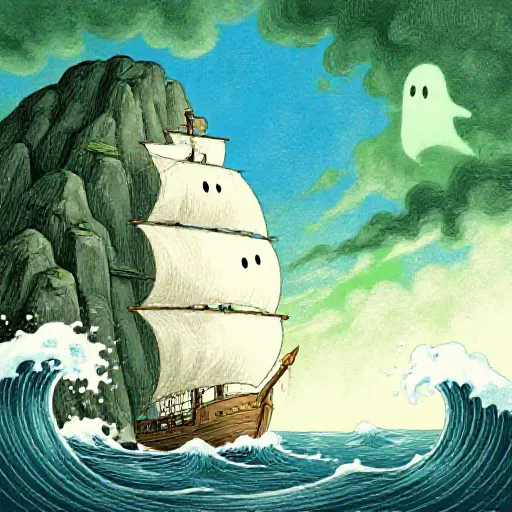
The Cape was named by people who were hoping. Very, very hard. Sailors knew it differently. Waves three stories tall. Wind that comes in sideways with a sound like tearing canvas. You can see the cliffs while the water takes you, which is the particular cruelty of the place. Dying within sight of land. That is a design choice by whoever built the ocean, and it is not a kind one.
By the 1600s, sailors left offerings at the rail before the approach. They lowered their voices. Some crossed themselves and did not speak of it at all.
A Dutch captain named Hendrik van der Decken sailed toward it in a storm in 1680.
He did not lower his voice.
He was that kind of captain. You know the type. Every workplace has one.
The Oath (Which Was a Terrible Idea)
The storm met him three days out from the Cape. It came in low and fast, the clouds piling on top of each other like someone stacking boxes in a hurry, and by nightfall the swells were running so high that the ship dropped into the troughs and the sky disappeared.
The crew wanted to turn back. The first mate, who was a reasonable human being with a working survival instinct, said the ship would not make it.
Van der Decken was not interested in that opinion.
He ordered the course held. When the helmsman tried to turn the wheel, the captain nailed his hands to it. I am not being dramatic. He drove iron nails through the man's palms and into the wood of the wheel so that it could not be turned. Then he shot the first mate in the chest and threw him overboard into the black water.
Cool. Great. Love that for the crew.
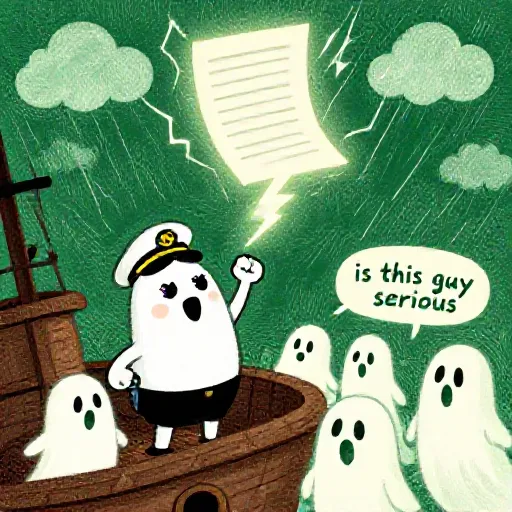
Then, standing on the quarterdeck in the rain with the ship heeling forty degrees and the sea pouring over everything, he made an oath into the wind. He would round the Cape if he had to sail until Judgment Day. Nothing would stop him. Not God. Not the Devil. Not the sea itself.
Here is the thing about making dramatic oaths into storms. Sometimes something is listening. Up in the storm, or below the water, or in that space between the two where the spray hangs and neither element owns the air. Something heard the oath and accepted it the way a contract is accepted.
The fine print was brutal. Van der Decken got exactly what he asked for.
I have never agreed with the phrase 'be careful what you wish for' more in my life.
The Crew Did Not Get a Vote
I want to talk about the crew for a second. Because this is the part of the story that genuinely bothers me, and I have thought about it more than is probably healthy.
The men who sailed with van der Decken that night did not agree to the oath. Nobody asked them. Nobody said, 'Hey quick show of hands, who wants to sail forever in an eternal storm because the captain has anger management issues?' There was no vote. No conversation. Not even a shout over the wind.
The captain made his bargain with whatever was listening, and the crew was folded into the terms like they were a line item. Terms and conditions applied. Nobody read the terms and conditions. Nobody ever reads the terms and conditions.
They have been sailing with him since 1680.
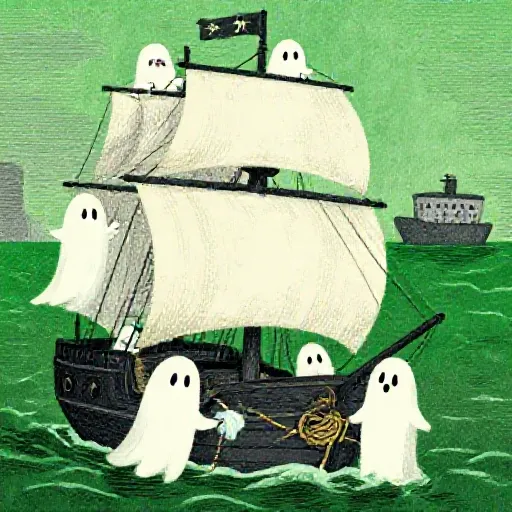
They work the ship. They climb the rigging. They haul the same ropes in the same storm that has not stopped in three hundred and fifty years. They do not age. They do not die. They cannot leave. They cannot file a complaint with anyone because the complaint department does not exist when your employer made a deal with a storm.
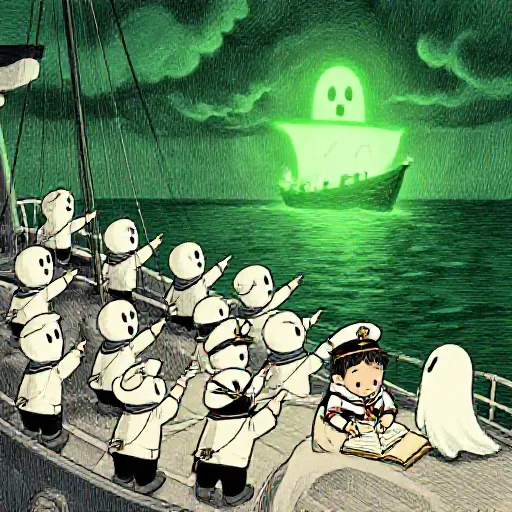
Sailors who have come close to the Dutchman report seeing figures at the rail. Men going about their work with the slow, mechanical precision of people who have done the same task ten million times and stopped caring about it somewhere around the second century. Their hands move. Their feet move. Their faces do not.
They do not wave. They do not call out. They watch passing ships with expressions that witnesses describe, consistently across three hundred years of accounts, as neither hope nor despair. Something past both. Something that comes after you have felt everything there is to feel and arrived at the empty space on the other side.
Doing the same job forever. In the same storm. For a captain you did not choose. With no way to quit.
That is its own kind of haunting, and honestly it is the scariest part of this whole story.

What It Means When You See It (Nothing Good)
The Flying Dutchman appears before storms. That is its whole thing. It is the weather forecast from hell.
When the barometer drops and the swells start running long and the old hands on deck go quiet the way animals go quiet before an earthquake, sometimes a ship appears on the horizon that is not on any chart. Sailing straight into the weather. Moving faster than the wind that should be pushing it. Lit from within on nights when no lantern could possibly stay lit. A cold greenish glow that sits on the rigging like someone left the Christmas lights on in 1680 and nobody has turned them off since.
It does not change course. It does not signal. It does not respond to radio contact, because it predates radio by about two centuries, which is honestly just rude.
It sails into the coming storm the way a needle finds north. As if the storm is the only fixed point it has left.
Old sailors knew what the sighting meant. The storm that took the Dutchman is the storm that is coming for you. Shorten sail. Batten everything. Pray if you are the type. If you are not, hold onto something solid and wait.
Of all the ghost ships reported by anyone, anywhere, in any ocean, across any century, none has been seen so often, by so many people who did not know each other, in so many different decades, as the Flying Dutchman.
That is either comforting or deeply, deeply not. You can decide. I have decided, and I am not sharing my answer because I do not want to make this worse.

One Night Off Every Seven Years (It Does Not Help)
There is one small mercy in the curse. I am using the word 'mercy' very loosely here.
Every seven years, the ship is allowed to anchor. The storm parts. The sea flattens. For one single night, van der Decken is permitted to come ashore.
He walks off the ship on legs that have not stood on solid ground in seven years and into whatever port town the current has delivered him to. He is looking for a woman who will love him faithfully until death. True love. Freely given. That is the key that breaks the oath. That is the clause in the contract he did not read before he signed it, which is really a lesson about reading contracts.
He has been coming ashore for three hundred and fifty years.
Picture this. He sits in port taverns at the far end of the bar with a single cup in front of him, wearing clothes that were fashionable in 1680 and have not been fashionable since. He speaks quietly to one person in a voice that sounds like it has not been used for conversation in seven years, because it has not.
Then he goes back to the ship before dawn. The storm closes. The anchor comes up. Seven more years begin.
Sailors who have spoken with him describe a man who is tired in a way that sleep cannot fix. Tired in the bones. Tired in the wanting.
Three hundred and fifty years of first dates that go nowhere, and then back into the storm.
That part is just sad. There is no joke for that part. I tried. It is just sad.
The Last Time Anyone Saw Him (Well, the Last Official Time)
The most recent sighting in the official record is from 1942. A South African naval crew reported a strange vessel on the horizon near the Cape during a night watch. Visible for several minutes. Glowing faintly. Then gone, the way a candle goes out. Not gradually. All at once.
But the one that really gets me is the British one.
In 1881, Prince George, who would later become King George V, was a sixteen-year-old midshipman aboard HMS Bacchante. The ship's official log recorded a luminous vessel off the port bow near the Cape. Thirteen men saw it. Thirteen. They described it independently and their accounts matched.
The officer who first spotted it from the rigging fell to the deck and died before the day was out.
Thirteen is a weirdly perfect number for this story, by the way. If you were writing fiction you would not pick thirteen because it would feel too obvious. But this is not fiction. This is the ship's log of a Royal Navy vessel, and thirteen men saw the thing, and one of them died, and nobody offered an explanation at the inquiry.
The storm came three hours after the sighting. Just as it always does.
Van der Decken rounds the Cape again and again. The same headland. The same storm. The same passage that he swore to complete, over and over, in a loop that has no end because he built it that way himself.
With his own oath. With his own stubbornness. With nails and a pistol and the absolute certainty that he was right, which is how most eternal punishments start, if you think about it.
Good night. Stay off the ocean. Actually, just stay out of the water generally. Between this and La Llorona, water is having a really bad week.
The True History
The part where we tell you what actually happened.
The legend of the Flying Dutchman appears in European maritime folklore as early as the late 17th century and is most strongly associated with the Cape of Good Hope trade routes. The earliest written accounts describe a Dutch captain who swore a blasphemous oath and was condemned to sail forever as punishment. The captain's name varies across sources: van der Decken, van Straaten, and Falkenberg all appear in different traditions. The specific detail of the nailed helmsman and murdered first mate is not present in all versions, but the core of the oath and the eternal sailing is consistent. The 1881 sighting by HMS Bacchante is documented in the ship's official log and was published in an 1893 memoir by the Duke of Clarence. Prince George, who later became King George V, corroborated the account. The logbook entry is among the most widely cited paranormal maritime records in existence. The death of the lookout following the sighting is noted in the same records. Richard Wagner wrote an opera based on the legend in 1843, which introduced the redemption arc: the captain can be freed by a faithful woman's love. This element may be an invention of the 19th-century romantic tradition rather than an original part of the folklore, but it is now so embedded in the story that separating it is nearly impossible. Whether Van der Decken is looking for rescue or simply condemned to look for it forever depends on which version you believe.