The Valley That Doesn't Sleep Well
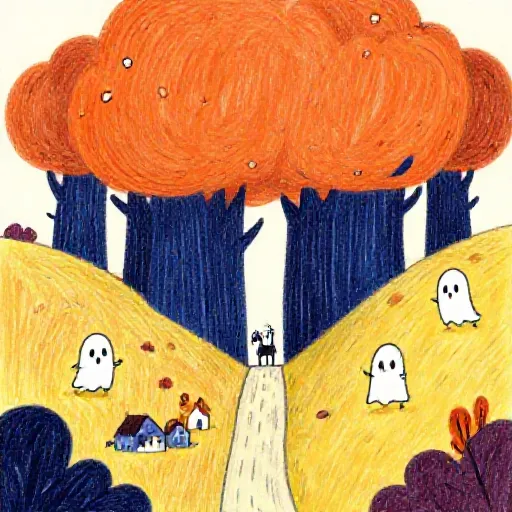
Okay. So. New York. 1790. Not the city. Upstate. The Hudson Valley. There is a village called Sleepy Hollow that sits in a dip between hills like something the landscape is trying to swallow. The Dutch settled it in the 1600s and named it, loosely translated, the Sleepy Country. Which sounds nice. It was not nice. It was a warning.
The trees along the road grow so close together that noon looks like dusk and dusk looks like the inside of a closet. Sound does strange things in this valley. An echo comes back from a direction it has no business coming from. A voice carries a quarter mile through woods that should swallow it in ten feet. The locals knew which stretches of road went quiet before they should. They knew the bend near the old Dutch church where horses would stop dead and refuse to move, ears flat, eyes rolling, every single time.
Nobody explained this to Ichabod Crane when he moved there in 1789.
Ichabod was a schoolteacher from Connecticut. He showed up with a trunk of books and the general posture of a man who has never once been in a fight. Nobody sat him down. Nobody said, hey, quick heads up, the road at night is a whole situation. He just moved in. Set up his little schoolhouse. Started teaching.
Which is fine. People move to new places all the time without reading the reviews. But Sleepy Hollow is the kind of town that has reviews for a reason, and Ichabod did not check any of them.
The Schoolteacher Who Believed Everything
Let me describe Ichabod Crane to you, because he is important and also he looks like a cartoon before cartoons existed.
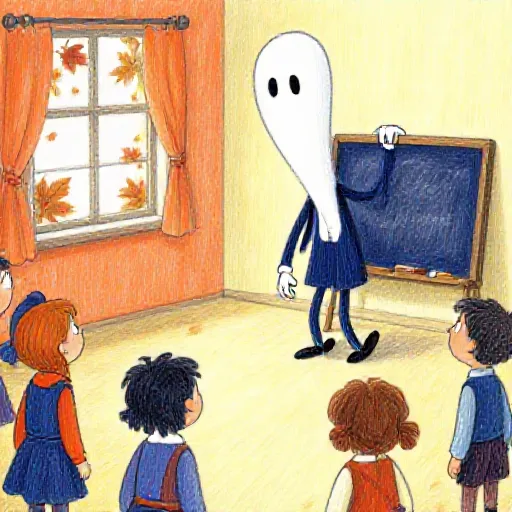
Tall. Very tall. But narrow, in a way that made the tallness worse. His neck was doing most of the work. It stuck out of his collar like a periscope on a submarine that had committed to getting a look around. His elbows jutted. His knees jutted. His hands hung at the ends of his arms like they had arrived from a different order and were still being processed.
He had read a lot of books. He believed all of them. Cotton Mather on witchcraft. Local accounts of ghosts in the pine woods. Every single spooky story anyone had ever told him over a kitchen table after dark. He absorbed all of it the way a sponge absorbs soup, totally and without filtering. This made him very educated and very, very easy to scare. Which is a combination.
His strategy for dealing with dark roads was whistling psalms. He believed whistling kept things away. There is zero evidence for this. Not a shred. He was essentially using hymns as antivirus software, and the subscription was not valid.
He was also, and I want to be clear about this, extremely focused on money for a schoolteacher. He had noticed Katrina Van Tassel. Specifically, he had noticed her father's farm, her father's orchards, her father's livestock, and her father's dinner table, which was the kind of table that made Ichabod's eyes go slightly unfocused.
He was not a complicated man. He wanted food, money, and for ghosts to be real but also to leave him alone. Two of those three were going to be a problem.
The Party Where Everything Goes Wrong
In autumn, the Van Tassels threw a harvest party, and this is where the entire story pivots from comedy to not-comedy in about forty-five minutes.
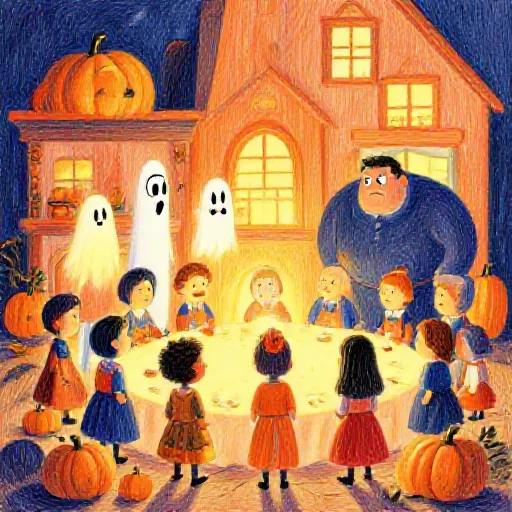
The farmhouse was glowing. Candles in every window. The smell of roast pork and pie crust drifting out into the cold night air where the horses stood steaming in the yard. This was the kind of party where the food was the main event, and Ichabod arrived early with the focus of a man who had been mentally rehearsing this meal for weeks.
He ate. He ate in a way that suggested he was trying to store calories for a future emergency. He danced with Katrina. He was not good at dancing, but he was tall, and in candlelight you can sometimes get away with being tall instead of being good. It worked for about two songs.
Brom Bones was also there. Brom Bones was the opposite of Ichabod in every measurable way. Big. Loud. Built like a wardrobe that had learned to walk. He also liked Katrina. He did not like Ichabod. He made this clear through a series of elaborate pranks that Ichabod chose not to fully process.
Late in the evening, the old men gathered by the fire and started telling ghost stories. Because of course they did. The big one was the Headless Horseman. A Hessian soldier from the Revolutionary War, killed by a cannonball that removed everything above the shoulders, buried in the churchyard at the edge of the Hollow. He rode out at night looking for what he lost.
Ichabod laughed along with everyone else. Cool. Great. Fun party story.
Then the party ended. The candles went out. The yard emptied. And Ichabod had to ride home. Alone. Through the valley. At midnight. On a borrowed horse.
This is the part where the story changes temperature.
The Ride Nobody Wants to Take
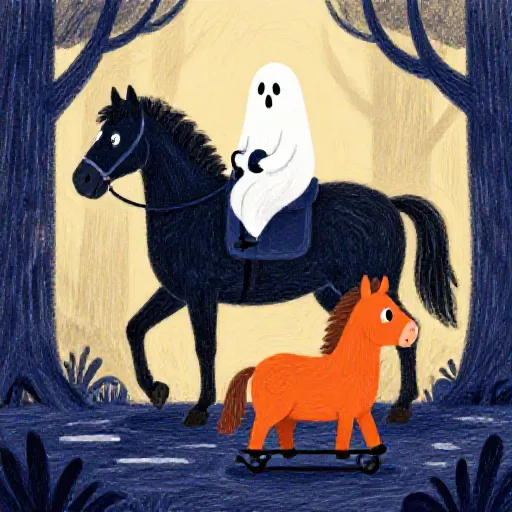
Ichabod's horse was named Gunpowder, which is a great name for a horse and a terrible match for this particular horse. Gunpowder was old. Gunpowder was borrowed. Gunpowder walked with the enthusiasm of something being led to a chore it had already mentally declined.
The road home wound through every single location from every single ghost story he had just heard. The hollow tulip tree. The little wooden bridge over the creek. The churchyard where the Hessian soldier lay under six feet of Dutch dirt with nothing above the neck. It was like someone had designed the route specifically to be the worst possible walk home after a ghost story marathon. Like a haunted corn maze, except it was real and nobody was selling funnel cake at the exit.
The trees closed over the road like a ceiling. Moonlight came through in pale pieces that looked like things they were not. He heard sounds and told himself: branches. He saw shapes and told himself: stumps. He whistled. The whistling sounded incredibly small.
Then, near the bridge, he heard hoofbeats behind him.
Slow. Matching his pace exactly. The way someone matches your stride when they want you to know they are following you and are in no rush whatsoever.
He looked back.
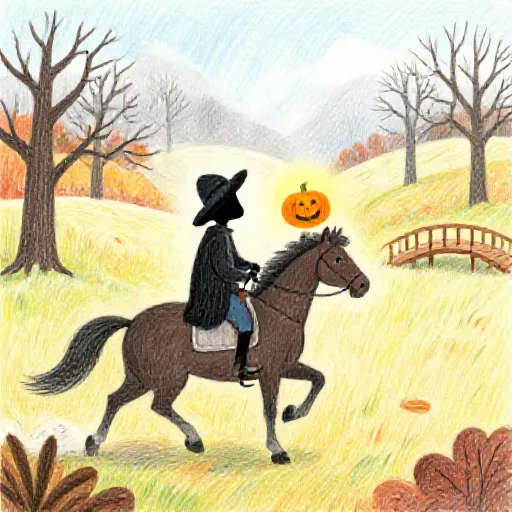
The rider on the black horse had no head. Where a head should be there was just night sky. He carried something round on the saddle in front of him, cradled against the pommel the way you would hold a bowling ball you did not want to drop. He sat tall and relaxed, the way a soldier sits who has done this particular commute many times before and enjoys it.
He was in absolutely no hurry.
Ichabod kicked Gunpowder and ran. Gunpowder, who had been moving at the speed of a grocery store checkout line, suddenly found a gear nobody knew existed. Which is relatable. Sometimes you need the right motivation.
The Bridge That Was Supposed to Help
Here is the rule everyone knew: the Horseman cannot cross running water. If you make it to the bridge over the creek, you are safe. The bridge is the finish line. The bridge is home base in the worst game of tag ever played.
Ichabod could hear the hoofbeats gaining. Closer every second. Heavy and measured, like a metronome that has decided to kill you. He did not look back again. He bent low over Gunpowder's neck and the old horse found something deep inside itself, some ancient reserve of horse adrenaline that had been waiting sixty years for exactly this situation, and they flew.
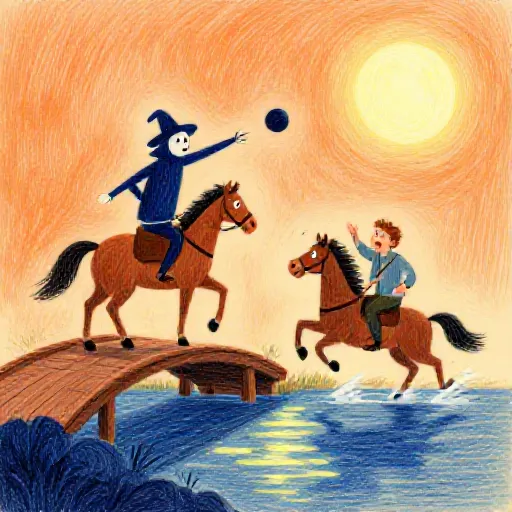
The bridge came up out of the dark. Wooden planks. The creek running black underneath. They crossed it.
He looked back.
The Horseman was at the edge of the bridge. Standing up in the stirrups. Arm drawn back.
You know the thing he was carrying on the saddle? The round thing?
He threw it.
You might want to grab a pillow for this part. Or a stuffed animal. Or another person's arm. Whatever is available.
It struck Ichabod square in the head and he went off the horse like a coat falling from a hook. Just. Gone. Gunpowder kept running without him, stirrups flapping, into the dark. Gunpowder did not look back. Gunpowder had done enough.
After that it was very quiet. The creek kept running. The trees stood where they had been standing for a hundred years. Nothing on the road moved at all.
The Morning and the Pumpkin
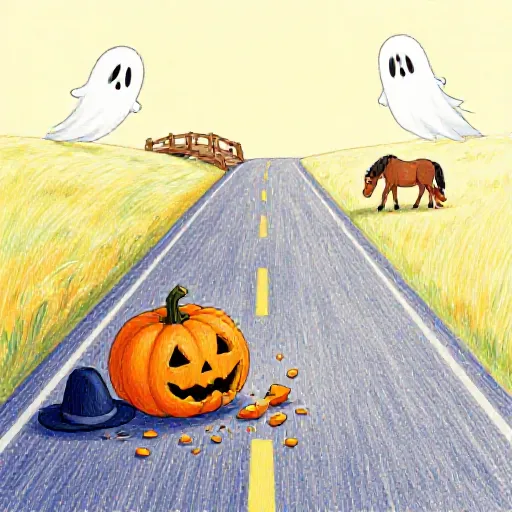
They found Gunpowder the next morning, grazing at the Van Tassel farm with the saddle slipped sideways, looking like a horse that had been through something and would prefer not to discuss it.
On the road near the bridge they found Ichabod's hat. Trampled flat into the mud. And next to it, a pumpkin. Smashed open. Seeds scattered across the dirt like small pale teeth.
No body. No Ichabod. No blood. Just the hat and the pumpkin and the quiet.
Now. Here is the thing. A severed head and a smashed pumpkin are two very different objects, and if the Horseman had been throwing an actual head, there would presumably be an actual head in the road. There was not. There was a pumpkin. Which raises questions.
The village talked about it for weeks. Some said the Horseman took Ichabod. Carried him off into whatever afterlife headless soldiers maintain. Some said Ichabod was so thoroughly terrified that he just kept running. Past the bridge. Past the county line. Past the state. Never looked back.
A few people noticed that Brom Bones laughed a very specific way during the ghost story part of the party. A big, wide, knowing laugh. The laugh of a man who is not just enjoying a story but is previewing his own work.
Brom Bones married Katrina Van Tassel that winter. He never mentioned Ichabod except to laugh. He always laughed hardest at the part about the pumpkin.
The road through the Hollow is still there. The bridge has been rebuilt a few times. The trees still close over the road like a ceiling that does not want you to see the sky.
Was it a ghost? Was it Brom Bones in a black cloak with a pumpkin and a grudge and the upper body strength to throw it thirty feet in the dark? Washington Irving, who wrote this story down in 1820, never tells you. He sets up both answers and walks away. Because he understood that a story you cannot fully explain will outlast one you can.
Probably just a pumpkin, though. Probably. Sleep tight.
The True History
The part where we tell you what actually happened.
"The Legend of Sleepy Hollow" was written by Washington Irving and published in 1820 as part of "The Sketch Book of Geoffrey Crayon, Gent." Irving based the setting on the real village of North Tarrytown, New York, which sits in the Hudson Valley near a small river and an old Dutch Reformed church with a churchyard. The village officially changed its name to Sleepy Hollow in 1996, partly in recognition of Irving's story. The churchyard Irving described, with the grave of a Hessian soldier, is real. The bridge is real. Irving walked the road himself. The story's deliberate ambiguity about what actually happened, natural prank or genuine supernatural encounter, is central to its design. Irving leaves enough evidence for both readings. Brom Bones's laughter at the right moment, combined with the shattered pumpkin rather than an actual severed head, suggests strongly that Ichabod was pranked by a rival and ran. But Irving never confirms it. The story was written during a period of intense American interest in establishing a native folklore tradition, and Irving understood that a story without a definitive answer would outlast a story with one. Ichabod Crane was based partly on a real schoolteacher named Jesse Merwin who taught in the Sleepy Hollow area in the early 19th century, and partly on a real Jesse Ichabod Crane, a soldier from Kinderhook, New York. The Van Tassel farm is based on a real property. The Headless Horseman himself is rooted in a much older European tradition of headless riders, common in German, Irish, and Scandinavian folklore, that the Dutch settlers of the Hudson Valley would have carried with them from the old world into the new.