The Beautiful Part That Comes Before the Bad Part
Okay. So there is a woman.
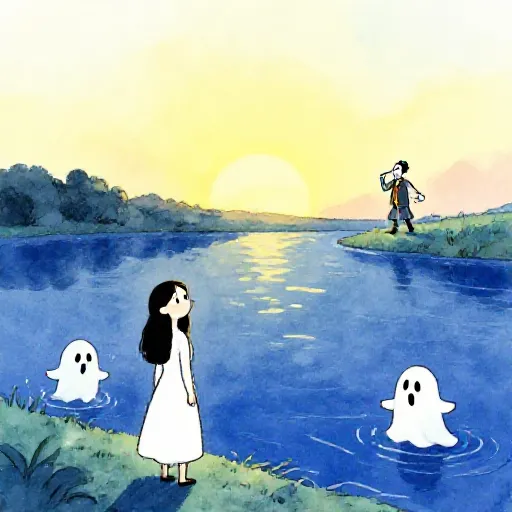
Every version of this story starts with a woman, and every version needs you to know she was beautiful. I do not know why that is the first detail to survive four hundred years of retelling, but here we are. Dark hair past her waist. A white dress. The kind of face that made a rich man look twice and then keep looking.
She lived near a river in Mexico. I cannot tell you which one, because the tale has been told in so many places that the river became every river. Folklorists have collected her along the Rio Grande, across central Mexico, up into the canals of the American Southwest, and the water is never the same water twice. Pick one. It does not matter. What matters is the water.
The rich man noticed her. He came from one of those families where the money goes back far enough that nobody remembers where it started, which is convenient, because the honest answer is usually 'nowhere good.' He loved her. Or he loved looking at her, which is a different thing that feels the same for a while.
They had two children together. Small, dark-eyed, completely hers.
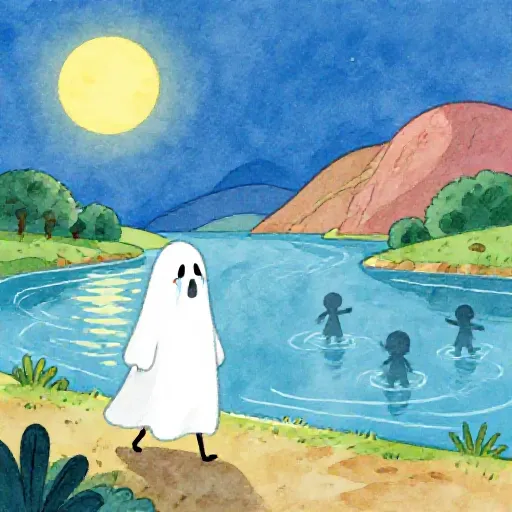
Then he found someone from his own class. Someone his mother approved of. Someone whose last name opened the right doors. He told her on an ordinary afternoon, near the river, while the kids splashed in the shallows and threw stones at their own reflections.
He spoke carefully. The careful voice. You know the one. The voice people use when they have already made every decision and they just need you to hear the words out loud so you can start adjusting to a thing that is already done.
Cool. Great. Love that for him.

The Part Nobody Wants to Tell
I am going to be honest with you. This chapter is not fun. The last one had a river and some kids throwing rocks and a man being a coward, which is manageable. This one is different.
Nobody agrees on exactly what happened next. The versions collected by folklorists diverge here, and the ones that line up are not bedtime material. But the shape of it is always the same: something broke inside her. Not cracked. Not bent. Broke. The way a green branch breaks when you push it past where it was ever meant to go. There is a sound that goes with that kind of breaking, and it is not a sound that stops.
The children did not come home that evening.
I need you to sit with that sentence for a second. I am not going to describe what happened at the river. You are smart enough to understand it, and I am not interested in making you picture it. The story has been told for centuries, and the people who tell it best are the ones who go quiet right here.
She walked into the village after dark. Soaked. The white dress clinging to her like a second skin. Her hair flat and heavy with river water. Her hands empty. She did not look at anyone.
By morning she was dead. Grief, some said. Others said drowning that took its time arriving. Others said nothing at all, which is its own kind of answer.
The children were found downstream a few days later. They were buried in the churchyard. She was not buried with them.
I need you to understand: that last detail matters. That is the hinge the whole rest of this story turns on. She was not buried with her children. Remember that.

The Worst Job Interview in the History of the Afterlife
So she dies. She shows up at the entrance to whatever comes next. Dripping wet. The white dress still on. River water still running off her hem like she brought the whole scene with her.
And someone at the door asks her one question.
Where are your children.
That is it. One question. Four words. And she has no answer. She has literally no answer. She had spent her last hours thinking about ending, and here she is, not ended, standing at a door that will not open because she cannot answer a question she should have thought about before she did the thing that made the question necessary.
I want to be clear about this, because it is the part people underrate: this is the worst possible outcome. Not hell. Not fire. Not punishment you can scream at. Just a closed door and a question you cannot answer. That is somehow worse than all of it.
Go back, she was told. Find them. Bring them with you.
So she went back. To the river. The same river. The same stretch of bank where the stones were still warm from an afternoon that was already, somehow, centuries ago. She searched in the dark, her white dress trailing through the mud, calling their names in a voice that no living throat should be able to produce.
She has been calling their names ever since.
Two hundred years, some tellings say. Four hundred. Longer. The river does not keep track. The river just keeps running in the same direction. Never arriving.
Neither does she.

The Sound Does Not Work Right (Pay Attention to This Part)
Okay. This is the part that genuinely unsettles me, and I have been reading ghost stories since I was old enough to hold a book wrong.
La Llorona has a sound. A wail. It starts low and rises, not like a siren, more like a question asked louder and louder because nobody is answering. There is searching in it. There is anger at the edges. But mostly it is the sound of a woman looking for something she already knows she will not find and cannot stop looking for, because stopping would mean it is real.
Now. Here is the important part. I need you to pay very close attention.
The sound does not work the way sound is supposed to work.
When the crying is far away and faint, she is close to you. When it is loud and fills the air until you feel it in your teeth, she is somewhere else entirely, working a different stretch of bank, moving away.
This is not a riddle. This is not me being dramatic. This is how the tellings describe her. Distance and nearness have rearranged themselves around her grief like a river bending around a stone that should not be there. The physics broke. The rules changed. Nobody filed the paperwork.
When the wailing gets softer: she is walking toward you.
When the wailing stops completely: she is standing right beside you. Close enough that you would feel her breath on your neck, if she still had any.
And there is a reason this exact detail survives in so many versions, hundreds of miles apart. Folklorists have pointed out that it is a warning with a job to do. It teaches children that the quiet water is the dangerous water. Fear does the teaching that instruction could not. I have thought about that for a long time and I do not like it even a little bit.
You might want to pull the blanket up for the next chapter. I will wait.

She Has Been Doing This for a Very Long Time
She has been reported by countless people across centuries and a whole continent. That is not an exaggeration meant to spook you. It is just what the collected record looks like. Accounts have been written down by folklorists on both sides of the border since at least the 19th century, and the volume of them is the point.
The details barely change. White dress. Dark hair loose and wet. A riverbank. Weeping. She is always facing the water. She is always looking down. The consistency across four hundred years of independent tellings, from people who could not possibly have coordinated their stories, is, frankly, rude. It would be much easier to dismiss all of this if the accounts varied more.
They do not vary much. She wears the same thing every time. She has been wearing the same outfit for four centuries. That is its own kind of horror.
She is dangerous near water. She is most dangerous to children who are out after dark, near the bank, close enough that she can hear their voices through her grief the way you hear a familiar name called across a crowded room.
She has been known to mistake them for her own. In the dark, in the fog that clings to the water like something afraid to let go, she reaches for what she lost. She does not mean harm. That is somehow worse. She is simply not fully here anymore, and in her searching she confuses the living for the dead, because the dead are all she has thought about for a very long time.
This is exactly why the warning outlived the storytellers. Every grandmother in Mexico knows it. Every grandmother in the American Southwest knows it. The lesson is always the same. Stay inside after dark. Do not go near the water at night.
And if you hear crying that sounds far away, do not walk toward it.
The sound that seems farthest is the closest. I told you this already. I am telling you again because it is the kind of rule you do not want to learn from experience.

Every River. Every Night. Still Going.
She has been reported on the Rio Grande. On the rivers of central Mexico where the banks are thick with cottonwood and the night insects go silent when she passes, which is its own kind of review. When the bugs stop making noise for you, that is a one-star rating from nature.
She turns up along unnamed creeks and irrigation ditches and the muddy edges of parks where there is no river anymore but there used to be one, a long time ago, before the city paved over it. She follows the memory of water the way water follows low ground. She cannot help it. It is where they were.
Sometimes she is seen in daylight. Pale. Nearly see-through. Walking along a bank with her head down, her white dress dry for once, moving through the tall grass like smoke through a field. She does not notice the living when the sun is out. She is looking at the water.
At night she is different.
At night she is looking at you.
She will hold your gaze across the dark water the way someone holds your arm when they need you to understand something, and she will not let go until she is sure you are not what she is looking for. Then the wailing starts again, loud and raw, and you will know she has moved on.
You will be grateful for the loudness. Remember what I told you about the loudness.
Folklorists have been writing her down for a very long time, and the trail runs further back than most people expect. She surfaces in connection with Cihuacoatl, a Nahua goddess whom Bernardino de Sahagun's 16th-century informants described wailing through the night. She predates the Spanish. She predates the language most people tell her story in. She is older than the category we are putting her in.
Probably just a folk tale, though. Probably just a story mothers tell to keep kids away from the water at night. Probably nothing to worry about.
Go to sleep. Stay away from rivers.
Actually, just stay away from rivers.

The Paper Trail (Yes, There Is One)
Here is the thing people miss about La Llorona. She is not only a campfire story. She has a paper trail, and the paper trail is old, and it is stranger than the story lets on.
Start with the oldest thread. In the 16th century, a Franciscan friar named Bernardino de Sahagun spent decades interviewing Nahua elders and compiling what became the Florentine Codex, one of the most important records we have of the world the Spanish conquest was busy erasing. In it, among the omens said to have foretold the fall of Tenochtitlan, the great Aztec capital that fell in 1521, there is a woman. She is heard weeping in the night. She is crying out for her children. Nobody can find her.
Sit with the timing of that. People were reporting a weeping woman looking for her children before the city fell, and it got written down as a portent of the end of a world. This is not proof that La Llorona is real. It is something quieter and, to me, worse: proof that the sound of a woman weeping for her lost children was already, five hundred years ago, the sound a whole civilization associated with the end of everything.
Then the threads multiply. Scholars have long connected her to Cihuacoatl, a Nahua mother goddess Sahagun's sources described appearing and wailing at night. That connection is an interpretation, not a receipt, and honest folklorists say so. But it is one of the most cited origins for a reason. The pattern is just too consistent to ignore.
The written record keeps going. In 1960 a folklorist named Bacil Kirtley published a study of the legend and its variants in the journal Western Folklore, treating her the way you would treat any serious subject with a long documented history. Collectors like Americo Paredes wrote down her story again and again across Texas and the Southwest through the 20th century, and the same detail kept surfacing: parents using her to keep children away from the rivers and canals after dark.
That is the part that stays with me. Strip away the ghost, and you are left with a documented, centuries-long habit of an entire region telling its children the same warning through the same weeping woman. The scholars can argue about where she came from. What is not in doubt is how long people have been afraid of her, and how many of them wrote it down.
So. Probably just a folk tale.
Go to sleep. And really, stay away from rivers.
The True History
The part where we tell you what actually happened.
La Llorona, 'the Weeping Woman,' is one of the most widespread figures in Mexican and broader Latin American folklore, told across Mexico, Central America, and the American Southwest. Her core story is unusually stable across all of it: a woman drowns her children in a river after a man abandons her, dies, and is condemned to wander the water weeping and searching for them.
The 16th-century Florentine Codex, compiled by the Franciscan friar Bernardino de Sahagun from Nahua informants, records that among the omens said to have preceded the Spanish conquest of Tenochtitlan (the city fell in 1521) was a woman heard weeping in the night, crying out for her children. Folklorists frequently cite this passage as an early antecedent of the later La Llorona figure.
Scholars often link the weeping-woman motif to Cihuacoatl, a mother goddess in Nahua belief whom Sahagun's sources described appearing and wailing at night. This is an interpretation drawn by folklorists rather than a documented, unbroken line of descent, but it is among the most commonly cited possible origins of the legend.
The folklorist Bacil F. Kirtley published a study titled 'La Llorona and Related Themes' in the academic journal Western Folklore in 1960, one of many scholarly treatments that trace the legend's variants across regions and centuries.
Americo Paredes and other collectors of Mexican-American folklore recorded numerous La Llorona accounts in Texas and the Southwest during the 20th century, documenting how consistently the tale is used as a real-world warning to keep children away from rivers, canals, and irrigation ditches after dark.
The 'sound inversion' detail, that her cry seems faint when she is near and loud when she is far, appears across many regional tellings and works as a cautionary device: it teaches that silence near water at night is the thing to fear, not the noise.
More Ghost Stories
Since you made it this far.