Chapter 1
The road was empty until it wasn't.
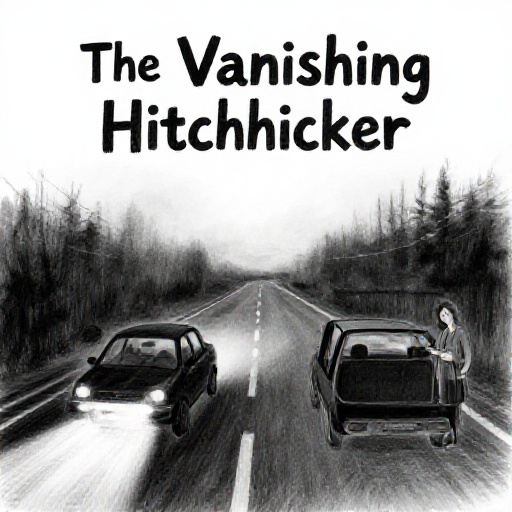
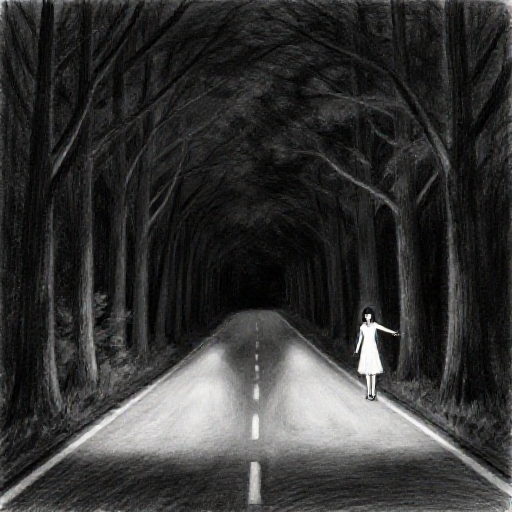
You know the kind of road: two lanes, no shoulder worth mentioning, the tree line pressing close on both sides. Headlights picking up maybe forty feet of pavement before the dark takes it back. The kind of road you stop noticing after twenty minutes because there is nothing to notice.
Then the headlights found her.
She was standing at the edge of the asphalt with her thumb out. White dress, or what looked like white. The kind of dress that belonged to a different decade. She was not a teenager. Not old. Somewhere in that middle distance where age becomes hard to read in the dark.
He slowed down. Of course he slowed down.
He told himself later he would have stopped for anyone on a road like that.
Chapter 2
She got in without much ceremony.
There was an address. A house somewhere ahead, she said, a few miles up. She gave the street, the number, the quiet confidence of someone who had been to that house many times and knew exactly how to get there from here.
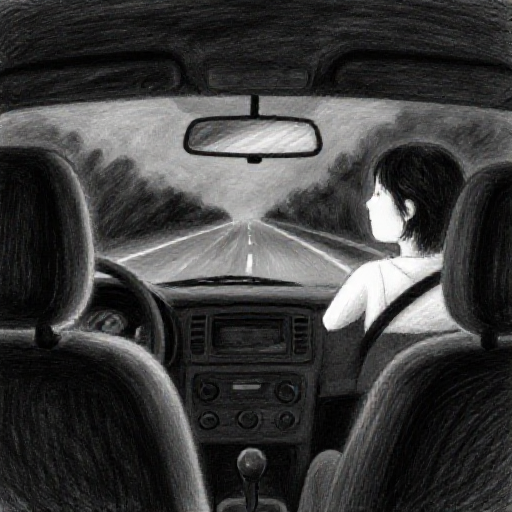
She did not ask where he was going. She settled into the back seat and said nothing else.
He drove. The radio played something he could not later remember. The tree line continued to press in on both sides. He tried a few conversational openings: the weather, the late hour, the distance still to go. She answered with the minimum required. Polite but somewhere else in her thoughts.
After a few miles he stopped trying.
The silence between them was not unfriendly. It was simply the silence of someone who did not need conversation to feel the weight of a car moving through the dark.
Chapter 3
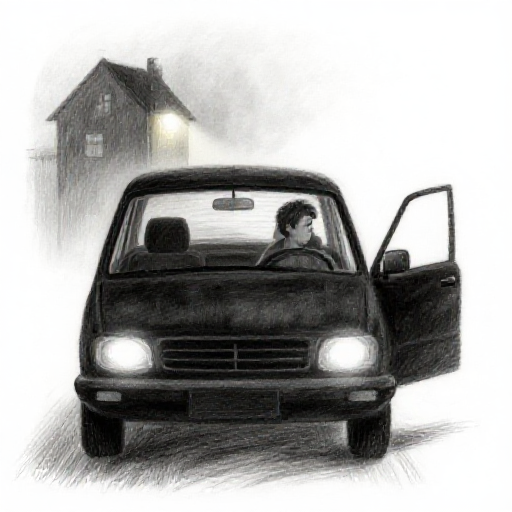
When he reached the address, he pulled into the gravel drive and turned off the engine.
He turned around to say they had arrived.
The back seat was empty.
The door had not opened. No sound of it, no rush of cold air, no vibration through the frame that a door opening at speed would have made. She was simply not there.
He sat for a moment with the engine ticking as it cooled.
Then he walked to the porch and knocked.
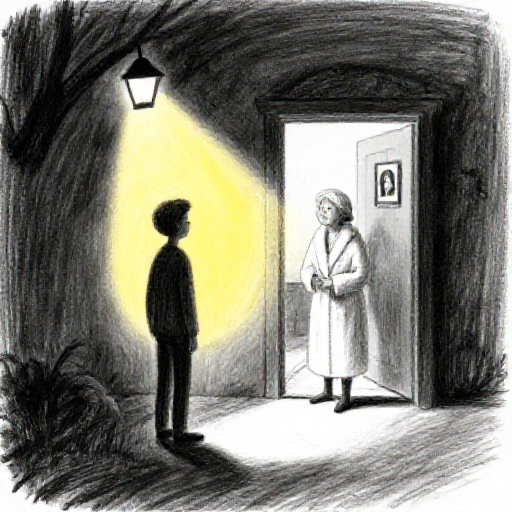
It took a while. A light came on upstairs, then the porch light, and then the door opened on an older woman in a bathrobe who looked at him the way people look at strangers on porches after midnight.
He described the woman he had picked up. The white dress. The address she had given. The way she had vanished from the back seat.
The woman on the porch was quiet for a long time.
Chapter 4
Her daughter, she said.
He had described her daughter. The white dress, she said, that was the dress they had buried her in. She had died on this date, on the road coming home, some years back now. The anniversary came every year and every year someone, sometimes more than one person, showed up at this door with the same story.
He stood on the porch and had no idea what to say.
She was not unkind about it. She had told this story enough times that the sharp edges had worn down. She thanked him for stopping. She said her daughter had always been the kind of person who got where she was going one way or another.
He walked back to his car.
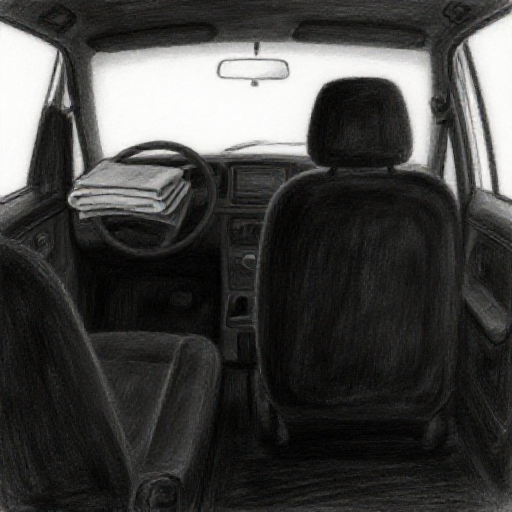
On the back seat, where she had been sitting, was a scarf. Folded neatly. Left the way you leave something when you mean to come back for it.
He had not seen her with a scarf. He could not have said where it came from.
Chapter 5
He kept it.
He was not sure what else to do. Returning it to the house seemed like the kind of thing you thought through and then could not bring yourself to do. Throwing it away felt wrong in a way he did not have language for.
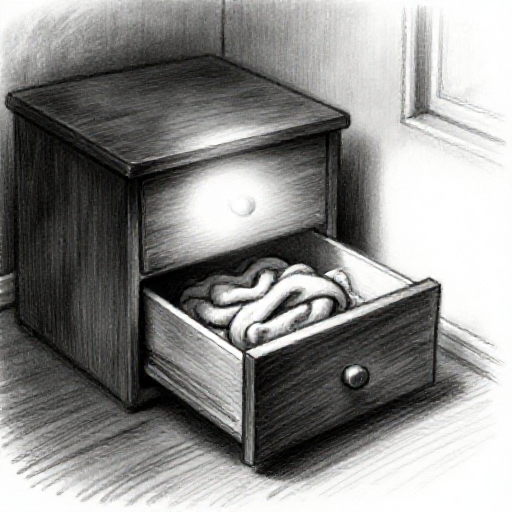
So it sat in his car for a while, on the back seat, and then one day he moved it to the glove compartment, and then after some months he brought it inside and put it in a drawer, and that is where it stayed.
He told the story a few times, to people he trusted. Some believed him. Some were politely uncertain. No one suggested he had made it up; he was not the kind of person who made things up, and more importantly, there was the scarf.
The scarf was always the part they could not account for.
Chapter 6
The story is older than any one telling of it.
It has been collected in America and England and Japan and Scandinavia. In each version, the shape is the same: a dark road, a stranger who needs a ride, an address given in the calm tone of someone who has been given that address their whole life. The backseat empty on arrival. The older person at the door with the older sorrow.
In some versions it is a coat left behind. In others a book, a purse, a set of keys.
Always something that should not be there.
The folklorists who have studied this story say it speaks to our need to believe that the dead still travel. That they still know the way home. That somewhere out there, on a road you know the feel of, someone is still trying to get back.
The scarf is in a drawer somewhere.
It smells faintly of something you cannot quite place.
The True History
The Vanishing Hitchhiker is one of the most widely documented urban legends in the world, studied extensively by folklorists as an example of a "migratory legend," a story that travels across cultures and centuries while preserving its essential structure. The American folklorist Jan Harold Brunvand, who popularized the term "urban legend," dedicated significant analysis to the story in his 1981 book "The Vanishing Hitchhiker: American Urban Legends and Their Meanings." Brunvand found over 79 distinct versions of the story collected by scholars, spanning multiple continents and dating back at least to the 1870s, long before automobiles existed, when the traveler arrived by horse and wagon.
The earliest versions are not American in origin. A Japanese variant involving a pregnant woman picked up by a rickshaw driver appears in Edo-period records. A Korean version describes a young woman visiting her home village after death. In the American tradition, the story crystallized in its current form during the early automobile era, approximately the 1930s, when hitchhiking was common and the combination of empty roads, strangers, and uncertainty made the scenario plausible to a wide audience. Specific real roads and real accidents have frequently been attached to local variants, giving the story geographical specificity that makes it feel like documentation rather than legend.
The "forgotten object" detail, the coat, scarf, or item left behind as physical evidence, is considered by folklorists to be a narrative anchor: it answers the objection that the driver simply imagined or hallucinated the passenger. The object is the proof. It cannot be explained away. Brunvand notes that this element appears across virtually all versions of the story in all cultures, suggesting that whatever deeper need the story serves, it requires physical evidence. The audience needs something that cannot be put back in the box.