Chapter 1
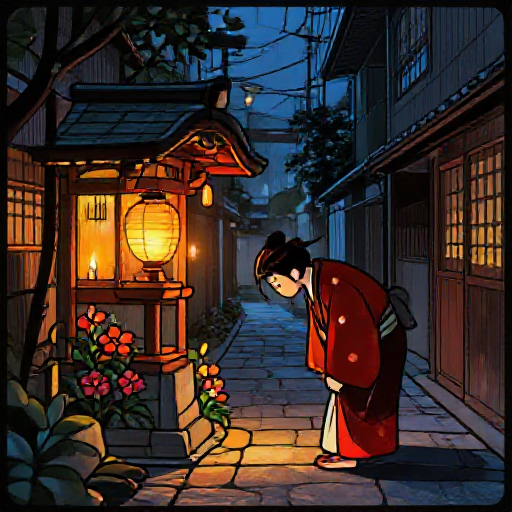
Before the curtain rises on the play, the actors go to her shrine.
This has been the practice for nearly two centuries. You do not perform the story of Oiwa without asking her permission first. Directors who skipped the ritual have lost fingers to set accidents, broken legs before opening night, gone blind in one eye during dress rehearsal. Coincidence accumulates, and eventually people stop calling it coincidence.
Her name is Oiwa. She died in the Yotsuya district of Edo in the early nineteenth century, betrayed by the husband she had organized her entire life around. She has not stopped being present since.
In the shrine on Samoncho, candles burn at all hours. The incense is always fresh. Someone is always attending.
This is not superstition. It is acknowledgment.
Chapter 2
Oiwa was a devoted wife in a country that expected devotion from wives and gave very little back.
Her husband, Iemon, was a ronin. A samurai without a master, which in the stratified world of Edo meant a man with pride and no particular outlet for it. He had debts, ambitions, and a wandering eye that eventually settled on the daughter of a wealthy neighbor.
The neighbor wanted Oiwa gone. He provided a solution in the form of medicine: a face cream, given to Oiwa under the guise of helping her recover from illness after childbirth. The active ingredient was a slow poison.
Oiwa used it. She trusted the gift because she had no reason not to.
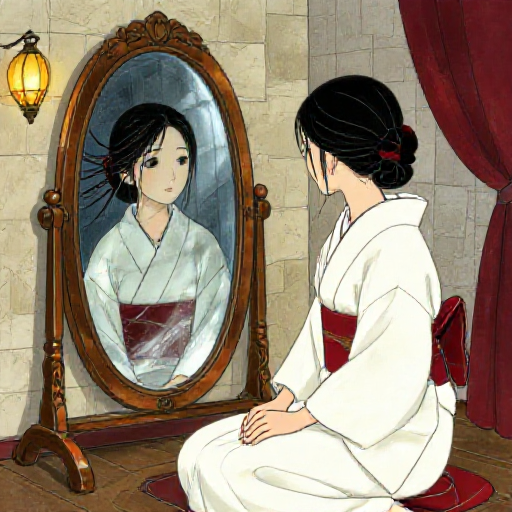
The poison worked as designed. Her hair began to come out in clumps. Her left eye drooped, then failed. Her face changed in ways that cannot be described without causing the reader to look away.
She did not know what was happening to her. She thought she was simply getting worse.
Chapter 3
Iemon looked at what he had done and felt, the historical record suggests, very little.
He arranged for Oiwa to be told that her masseur, a blind man named Takuetsu, had made advances on her. It was a lie designed to give Iemon a pretext for anger, for separation, for moving forward with the new arrangement. Oiwa, humiliated, horrified by her own reflection, confronted the masseur.
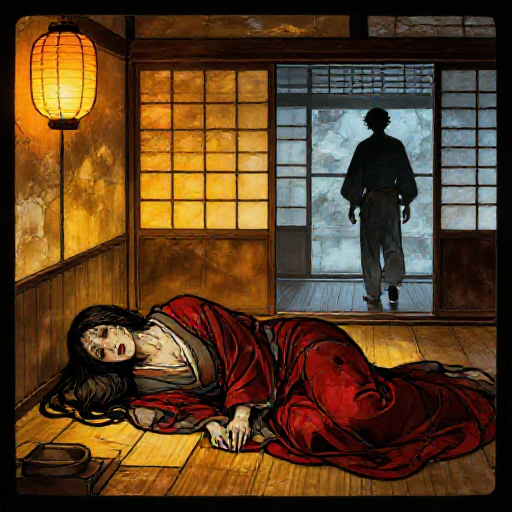
In the confrontation, or shortly after, she died.
The precise moment of her death has been told in many ways across two centuries of stage adaptations. In some versions she falls on a sword. In others she simply stops. The play has always been more interested in what came after than in the precise mechanics of the before.
What came after is the part that has never stopped.
Chapter 4
Iemon married his new wife quickly.
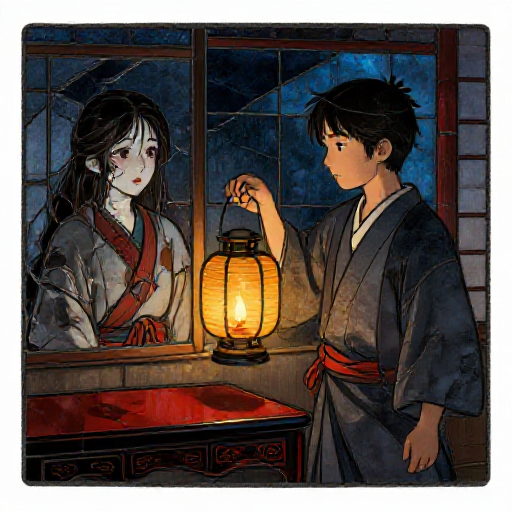
On the first night, he turned to her in the lamplight and saw Oiwa's ruined face staring back at him. The drooping eye. The thinned hair. The expression of someone who has been waiting for exactly this moment and has infinite patience.
He killed her. His new bride. With his own hands, in the belief that he was killing a ghost.
He was not killing a ghost. He was killing a woman who looked, in that particular light, in that particular moment, like the one he had destroyed.
The father came running at the noise. Iemon killed him too, adding another death to a debt that was already beyond repayment.
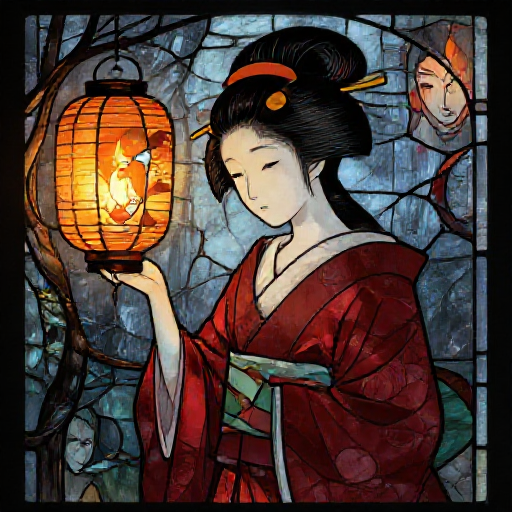
In the weeks and months that followed, Oiwa appeared in lantern flames. In the surface of still water. In every face that turned toward him in a crowd.
She did not speak. She did not need to. Her presence was the sentence.
Chapter 5
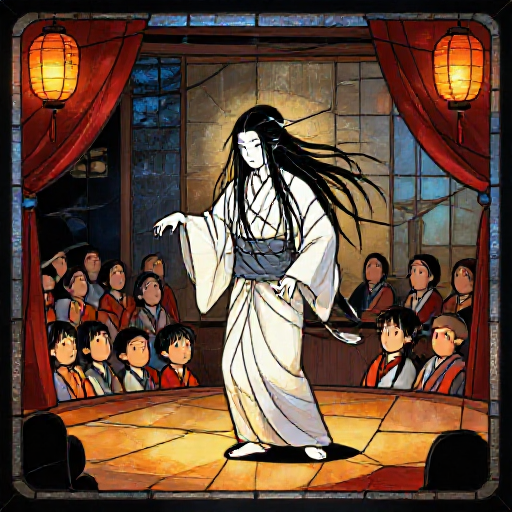
The playwright Tsuruya Nanboku IV wrote the story down in 1825, possibly drawing from real events in the Yotsuya district, possibly from accumulated urban legend, most likely from both.
"Yotsuya Kaidan" became one of the most performed plays in kabuki theater. It has been adapted into film dozens of times. It has traveled across the world. Oiwa's image, the long black hair, the damaged eye, the white burial kimono, became the visual template for the vengeful female spirit in Japanese horror that persists to this day.
But the shrine on Samoncho predates the play. There is a record of a grave there for a woman named Oiwa, a real woman, who died young under unhappy circumstances.
Whether the historical Oiwa and the theatrical Oiwa are the same person has never been resolved. The shrine does not care about the distinction. The candles burn regardless.
Chapter 6
Actors still go.
Before filming an adaptation. Before opening night. Before any new production takes the stage anywhere in the world where there are people serious about what they are doing.
They bring offerings. They bow. They ask, in their own way, if she is willing to let this telling happen.
The ones who skip this step tend to remember it.
Oiwa is not famous because of the play. The play is famous because of Oiwa. She existed before Nanboku wrote a word, and she will exist after the last performance is given and the last theater goes dark.
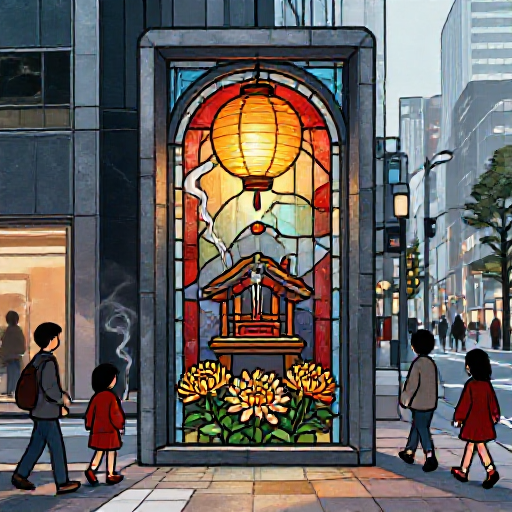
In the Yotsuya district, in a building where her house once stood, there is a shrine so small you could miss it if you were not looking. Flowers placed that morning. Incense not yet burned down.
Someone was here recently.
The True History
Yotsuya Kaidan, written by Tsuruya Nanboku IV and first performed in Edo in July 1825, is considered one of the greatest works of kabuki theater and one of the foundational texts of Japanese horror. Nanboku set the play in contemporary Edo rather than the historical past, which was unusual for kabuki and gave the story an immediacy that rattled audiences. The play was originally performed as a companion piece to a Chushingura adaptation, meaning audiences watched the revenge story of the 47 ronin and then immediately watched Yotsuya Kaidan, with some actors playing roles in both. The pairing was intentional: loyalty rewarded on one side, loyalty punished on the other.
The superstitions surrounding the play are thoroughly documented and taken seriously by the Japanese entertainment industry. Multiple film productions, particularly the Toho adaptations of the mid-twentieth century, have recorded accounts of accidents, illnesses, and strange incidents during filming that cast members attributed to failure to properly honor Oiwa before production began. Director Nobuo Nakagawa's 1959 adaptation is considered the definitive film version. Its cast made the shrine visit before filming began. The production completed without incident. This contrast with less careful productions has been noted repeatedly by Japanese film historians.
The Oiwa Inari Tamiya shrine exists in the Yotsuya area of Tokyo and receives visitors continuously. Whether a historical woman named Oiwa was the basis for the play, or whether the shrine was established in response to the play's popularity, remains a subject of debate among scholars. What is documented is that the shrine predates the first surviving records of the play's cultural impact, which suggests a real person at the origin. The image Nanboku created, the female spirit with long black hair obscuring a damaged face, became so prevalent in Japanese culture that it influenced the global visual grammar of horror, most directly through Koji Suzuki's Ring novels and the films they generated.