
The Setup
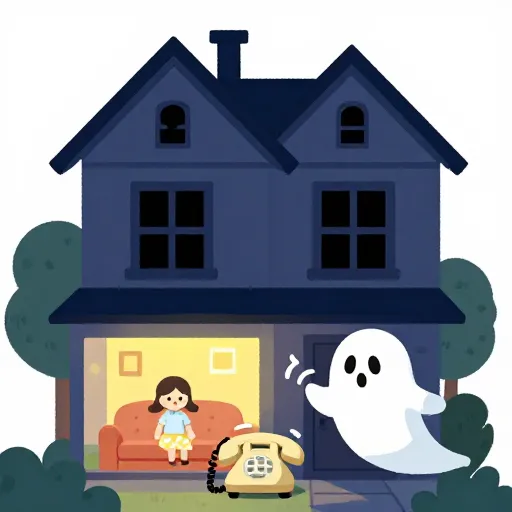
The parents are very nice. The house is very nice. There are two children upstairs who have been good all evening and are now asleep, and there is a babysitter on the couch, and everything is perfectly fine.
That is the important part. Everything is perfectly fine at the beginning. The babysitter is a teenager who has done this before. The family left emergency numbers on the refrigerator, the way families do, there is leftover lasagna labeled 'help yourself,' and the television is on a channel that is fine.
The house is in a suburb, built sometime in the 1960s, and it has the particular feeling those houses have: slightly hollow walls, a kitchen that smells like dish soap, carpeted stairs that you would not hear anyone climbing if, for instance, they were being careful.
The children have been asleep for forty-five minutes. She checked on them once, saw two small lumps under two small comforters, heard small quiet breathing, and felt the pleasant uncomplicated satisfaction of a job going well. Three hours until the parents come home. Shoes off. Lasagna in reach. The television loud enough to cover most sounds.
The phone on the end table is beige. It is the particular beige of the 1970s, the beige that says this object will still be here in forty years and will cause tremendous problems. It has a long cord, coiled, with a little flexibility left in it.
The phone has not rung yet.
The phone is about to ring.

The First Call
The phone rings.
This is not unusual. The phone rings sometimes. She picks it up.
No one answers. Not quite. There is something. Breathing, maybe, or the ambient noise of a room, the particular acoustic signature of a space, the way you can sometimes hear that someone is there even if they say nothing. Then the line goes dead.
She puts the phone down. Telemarketer. Wrong number. Someone who dialed incorrectly and was too embarrassed to speak. This happens. She turns back to the television.
The phone rings again. Same thing. The same breath of presence on the line, and then a voice this time, quick and low, saying something she can almost catch, and then the click of disconnection.
She stares at the phone.
I want to tell you that the babysitter now does the sensible thing, that she calls the operator, or contacts the police, or at minimum locks the front door, which she has just remembered is unlocked. She does not do the sensible thing. She does the thing people do, which is to decide it is probably nothing and wait for it to happen again.
It happens again.
The third call is longer. The voice is clearer. It is a man's voice, which is a specific kind of wrong, because there is no man in this house tonight, and the man on the phone is not asking if she needs anything or checking on the children.
He is asking if she has checked the children. He says it in the tone of a question, but it is not really a question.
The babysitter checks the children.

The Escalation
The children are fine. She can see them breathing. She pulls the doors almost-closed, the way they were before, and walks back downstairs with the specific careful lightness of someone who does not want to acknowledge that they are scared.
The phone rings again. She picks it up. The man on the other end says: 'Why did you go upstairs?'
This is the moment that changes things, because he knew she went upstairs. There is no way to know that unless you were watching. She looks at the front door, which she has now locked. She looks at the windows, which face a dark suburban street. She looks at the staircase.
The staircase goes up. She does not look up the staircase for very long.
She calls the operator. In 1960s and 1970s America, an operator could manually trace a call, but it took time. You had to keep the caller on the line. You had to call back, get the trace started, and then wait.
So when the phone rings again, she picks it up. The man says things. He says them calmly. This is the detail that shows up in almost every version of this story: the voice is calm. Not threatening in the way of television villains. Calm in the way of someone who has already decided what is going to happen and finds the present moment unremarkable.
She keeps him talking. She does not know exactly what she is doing, she is just keeping him talking, because the operator is working on something and there is a feeling, faint but present, that the right thing to do is to stay on the phone.
The operator calls back on a different line. The operator says something.
The something is not good.

The Trace
The operator says: the call is coming from inside the house.
There it is. The sentence. The one that has lived in the American cultural brain since at least the 1960s, the one that got repeated at slumber parties and around campfires and at lunch tables for decades until it became one of the most famous horror sentences ever built in plain English.
The call is coming from inside the house.
Think about what that means, practically. There is an extension phone upstairs, in the house. Someone has been in the house this whole time, using the upstairs phone, calling down to the babysitter on the ground floor, watching her through the ceiling from above.
The stairs are carpeted. You would not hear anyone on those stairs if they were being careful.
The operator says: get out. Leave immediately. Do not go upstairs.
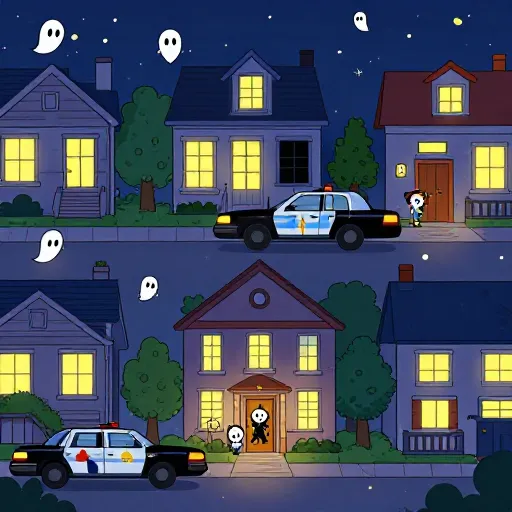
The babysitter leaves. She goes out the front door and to a neighbor's house and calls the police, and the police arrive, and they go upstairs.
What they find upstairs varies by version. In some tellings the man is still there, caught. In others he is gone, and what he has done to the children is not shown. In still others the children are unhurt and sleeping and the man has simply vanished, which is somehow worse: no explanation, no body, no answer to the question of what he wanted.
The story does not have an ending, exactly. It has a moment: the phone rings, the voice says 'have you checked the children?' and the babysitter, knowing now what she knows, picks up the phone anyway.
Because what else do you do. You pick up the phone.
The Reveal
What makes this story last is not the scare. Horror stories fade. The specific texture of a scare, the sharp intake of breath at a particular moment, wears off.
What lasts is the setup. The house is safe. The children are asleep. Everything is perfectly fine. And somewhere in the background, so routine as to be invisible, the phone keeps ringing.
The terror is in the ordinary. In the couch and the television and the lasagna and the beige telephone. In the fact that something terrible can be happening in the room directly above you and you will not know until the phone rings, and it will ring in the voice of a man who sounds calm.
Every element of this story is mundane. Suburb. Babysitter. Children. Phone. The horror is that it uses the furniture of safety to build something that isn't safe at all.
The other thing that makes it last: it asks you to imagine being alone in a house. Really think about it. The sounds houses make. The upstairs, which you have to climb to. The phone, which is how you connect to help, being also how the danger announces itself.
Alone in a house at night is not a scary premise. Alone in a house at night with a phone that keeps ringing and a voice you can't quite place: that is a different thing.
The story has been told so many times that it has separated from any single event or location. It belongs to everyone now. Every suburb, every house with carpeted stairs, every teenager who has been alone with children sleeping upstairs.
Every version ends the same way. The call is coming from inside the house.
Janett Christman, 1950
Before the urban legend, there was a real girl.
Janett Christman was thirteen years old. It was March 18, 1950, in Columbia, Missouri. She was babysitting a three-year-old named Gregory Romack at the Romack family home.
Sometime that evening she reached the operator. She said a man was trying to break in. The operator relayed it to the police. Help did not reach her in time. By the time anyone arrived, Janett Christman was dead.
She had been strangled, and she had fought back. The three-year-old was found unharmed. A man named Robert Mueller was charged and went to trial. The jury could not agree. He was never convicted. The case was never solved.
The parallels to the legend are obvious: a young girl, alone, babysitting, a threat she tried to report, help that came too late. Whether the urban legend was directly inspired by her case or grew from the same anxieties that made her death feel universal is not something anyone can prove. Folklorists have traced circulating versions of the tale from the 1960s onward, spreading by word of mouth, by campfire, by telephone.
Her name faded. The story that may have grown from her situation became famous without her. The legend even got a blockbuster in 1979, 'When a Stranger Calls,' which pushed the phrase further into the cultural canon. That film carried no documented connection to Janett Christman. The story had already moved on, as stories do, into the general atmosphere.
Janett was thirteen. She tried to get help. She called the right people. The phone worked perfectly.
It just didn't work fast enough.
The Story Behind the Legend
So where does this one actually come from? People search for that. They want to know if the babysitter and the man upstairs is real, or where 'the calls are coming from inside the house' started, and the honest answer is layered, so let us take it in order.
First, the frame. This is an urban legend, not a single documented event. It is a story that traveled, changing shape as it went, the way legends do. The folklorist Jan Harold Brunvand studied it directly in his collections of American urban legends, including his 1981 book 'The Vanishing Hitchhiker,' and traced versions in circulation to at least the 1960s. He read it the way he read many of these tales: as a cautionary story that encodes a real social anxiety, in this case the vulnerability of a young woman working alone in a house that is not hers.
Second, the technology, because the story only works in one specific era. It belongs to the age before caller ID. To find out who was calling, you needed a telephone operator to run a manual trace, and you needed to keep the line open long enough for it to finish. That is the whole engine of the plot. A modern phone would flash the number on the screen and end the story in four seconds. The dread is a dread of not being able to see, and that particular blindness had an expiration date.
Third, the movies, because they are where most people actually met this legend. In 1974, 'Black Christmas,' directed by Bob Clark, built an entire film around a sorority house tormented by phone calls that are finally traced to a caller already inside the building, one of the earliest screen versions of the twist. Five years later, in 1979, 'When a Stranger Calls,' directed by Fred Walton, opened with a roughly twenty-minute babysitter sequence that dramatized the legend almost beat for beat and made 'the call is coming from inside the house' a household phrase. Walton had already filmed the idea once, as a 1977 short called 'The Sitter.' A remake of 'When a Stranger Calls' arrived in 2006. Between them, these films did what campfires alone could not, which was to fix a single line of dialogue permanently into the culture.
And fourth, the family it belongs to. The babysitter and the man upstairs is not a loner. It sits inside a whole cluster of American teen-scare legends built on the same machinery: an ordinary young person, a moment of safety, and a threat that turns out to be closer than anyone realized. You can hear the same bones in <a href="/stories/the-hook-man">The Hook Man</a>, in <a href="/stories/the-licked-hand">The Licked Hand</a>, where the reassuring thing in the dark is the wrong thing entirely, and in <a href="/stories/vanishing-hitchhiker">The Vanishing Hitchhiker</a>, the tale Brunvand named a whole book after. They spread through the same teenage networks, at the same sleepovers, and they survive for the same reason.
Which is this: the scariest place a story can put the danger is not out in the dark woods. It is upstairs, in the house you already thought was safe.
The True History
The part where we tell you what actually happened.
Janett Christman was thirteen when she was killed on March 18, 1950, while babysitting three-year-old Gregory Romack at the Romack home in Columbia, Missouri. She reached the telephone operator and reported an intruder before she was strangled; the child was found unharmed. A man named Robert Mueller was charged and tried, but the jury deadlocked and he was never convicted. The case remains officially unsolved. Folklorists and journalists have noted its resemblance to the later urban legend while cautioning that no direct, documented line connects the two.
Folklorist Jan Harold Brunvand collected and analyzed 'The Babysitter and the Man Upstairs' in his studies of American urban legends, including his 1981 book 'The Vanishing Hitchhiker,' and traced circulating versions to at least the 1960s. He described it as spreading through teenage social networks, the same demographic it depicts.
The 1974 film 'Black Christmas,' directed by Bob Clark, built its plot around a sorority house menaced by phone calls that police eventually trace to a caller already inside the building, one of the earliest big-screen uses of the legend's central twist.
The 1979 film 'When a Stranger Calls,' directed by Fred Walton, opens with a roughly twenty-minute babysitter sequence that dramatizes the legend and popularized the line 'the call is coming from inside the house.' Walton had first filmed the idea as a 1977 short titled 'The Sitter,' and a remake followed in 2006.
The legend is rooted in the pre-caller-ID era, when identifying a caller required a telephone operator to run a manual trace and the person receiving the calls had to keep the line open long enough for it to complete. That vanished technology is what makes the story's mechanics possible: the terror depends on not being able to see who is calling.
More Ghost Stories
Since you made it this far.